‘The Lunar Grotto’ - Agate Geode Skull with Raw Quartz Druzy Pocket · Specimen No. 02
Verfügbarkeit für Abholungen konnte nicht geladen werden
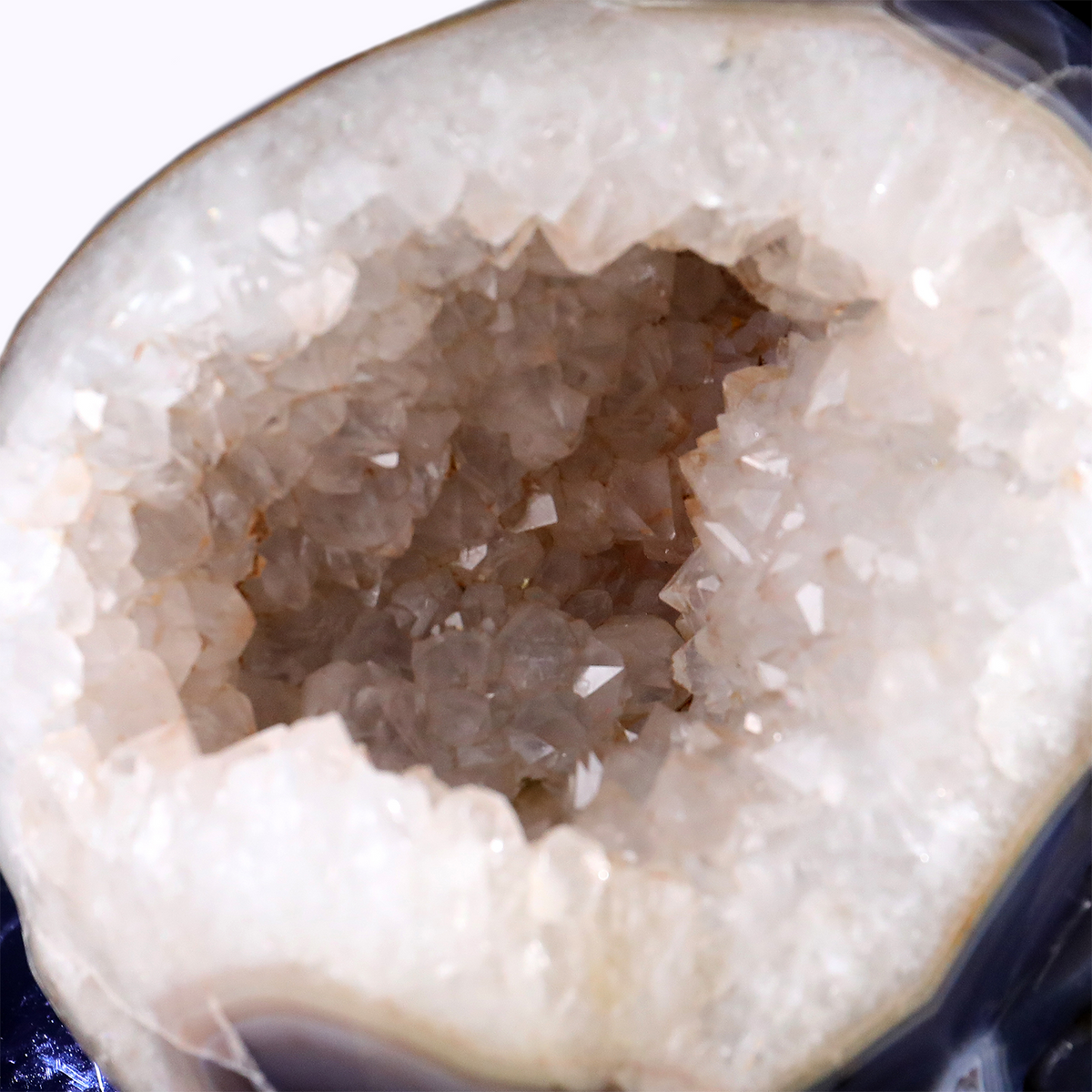
A broad cavity lined with white quartz points opens through the reverse of a polished blue-grey and white agate skull. Translucent facial areas, darker banded sides, and the recessed crystal interior create three distinct layers within the same natural geode nodule.
Material: Natural Agate Geode with Clear Quartz Druzy
Width × Depth × Height: 6.7 × 5.3 × 4.7 in (170 × 135 × 119 mm)
Weight: 7.51 lb (3,405 g)
Stone Origin: Undocumented
Edition: One of One · Specimen No. 02
Share

Material & Craft
The Material
This specimen retains the layered structure of a natural agate geode. Blue-grey banded agate extends across the sides and jaw, while pale translucent chalcedony occupies portions of the face and nasal area. The rear cavity is lined with fine clear-to-white quartz crystals. These materials are all forms of silica, but differences in crystal structure, scale, translucency, and surface texture create clear visual separation between the polished exterior and the reflective druzy interior.
The Sculpture
The solid portion of the nodule is carved into a human skull with a rounded cranium, recessed eye sockets, a defined nasal opening, shaped cheekbones, and individually divided teeth. The facial structure follows the denser agate and chalcedony areas, while the natural cavity remains open across the reverse. Its irregular rim forms part of the skull’s silhouette rather than being concealed by additional carving. The continuous polish of the exterior directs attention toward the contrasting raw crystal pocket behind it.
Form & Meaning
The title “The Lunar Grotto” draws on the specimen’s pale crystal interior and enclosed, cave-like structure. In art, the skull often represents mortality, memory, or the absent mind, while a grotto suggests a concealed space revealed only through an opening. Their combination allows the cavity to be read as an interior landscape: irregular, reflective, and materially different from the controlled anatomical surface surrounding it. This is a visual metaphor created by the form, not an attributed effect of the quartz.
One-of-One Commitment & Care
This is the exact sculpture shown in the photographs. Its chalcedony formation, host-rock matrix, inclusions, and color distribution belong to this individual stone. Once acquired, this specimen will not be restocked.
Dimensions and weight are measured by hand and may vary slightly from the stated specifications.
Care: Wipe the polished agate exterior gently with a clean, dry microfiber cloth. Remove dust from the crystal cavity with a soft natural-bristle brush or hand-operated air blower. Do not apply cleaning liquids directly inside the grotto.
Handling: Lift the sculpture with both hands supporting the solid lower base and jaw. Do not place fingers or other objects inside the rear cavity, and avoid pressure on its irregular rim and crystal points.
Storage: Place it on a flat, stable surface away from shelf edges, vibration, and high-traffic areas. Ambient or indirect backlighting may be used to reveal the translucent banding, but avoid heat-producing lamps positioned close to the stone.