Skip to product information
1 of 12

‘The Owl of Minerva’ - Hand-Carved Agate Owl and Stacked Skulls on Amethyst Druzy Slab · Specimen No. 11

‘The Owl of Minerva’ - Hand-Carved Agate Owl and Stacked Skulls on Amethyst Druzy Slab · Specimen No. 11

Regular price $4,900.00 USD
Regular price Sale price $4,900.00 USD
Sale Sold out
Shipping calculated at checkout.
Quantity

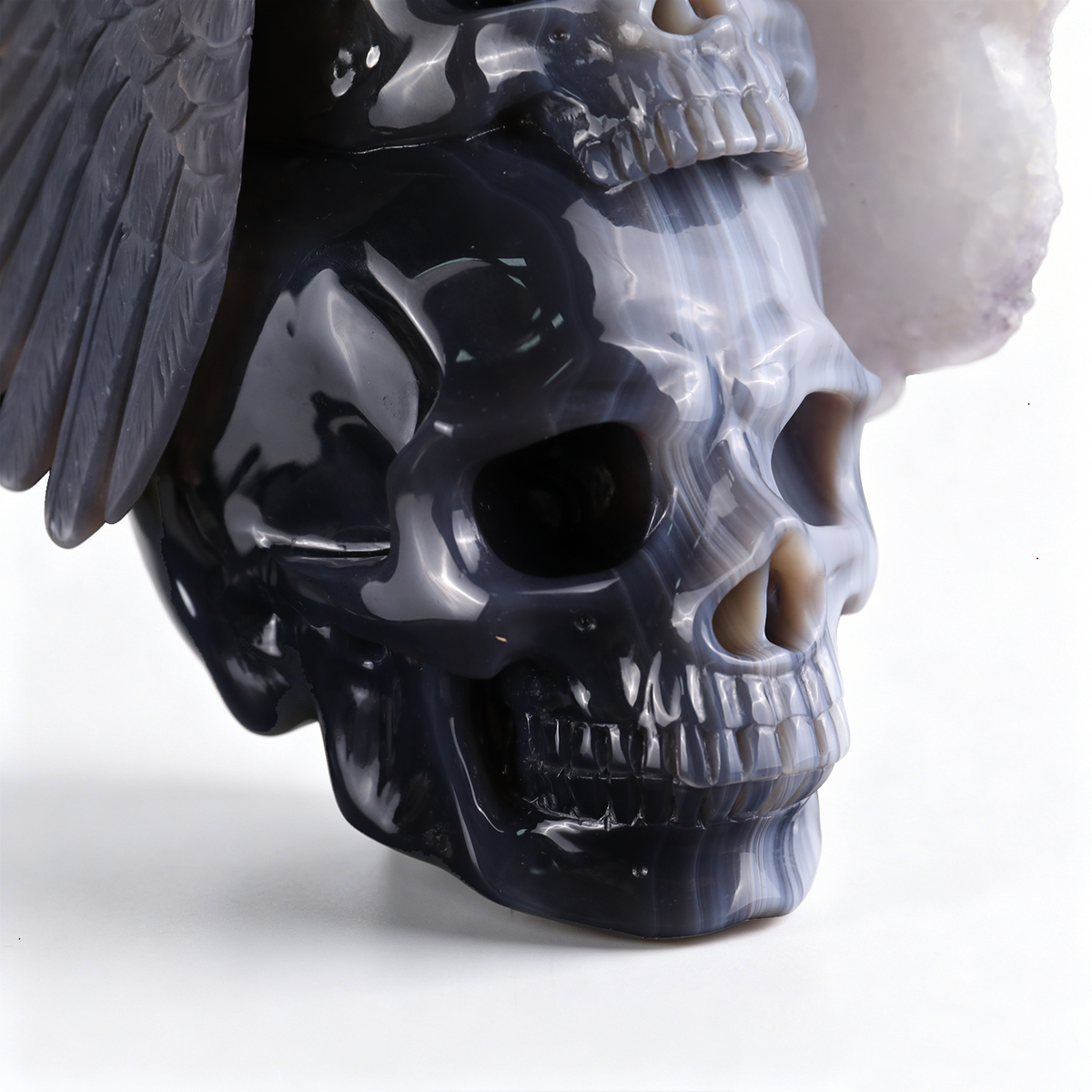
An agate owl spreads its wings above a vertical stack of carved skulls, backed by a broad slab of pale lilac amethyst druzy. Grey-black banding, lavender-toned plumage, and the reflective crystal field divide the composition into distinct layers of material and form.

Material: Natural Banded Agate with Amethyst Druzy

Width × Depth × Height: 5.7 × 4.7 × 11.0 in (145 × 119 × 279 mm)

Weight: 7.90 lb (3,581 g)

Stone Origin: Uruguay

Edition: One of One · Specimen No. 11

View full details
‘The Owl of Minerva’ - Hand-Carved Agate Owl and Stacked Skulls on Amethyst Druzy Slab · Specimen No. 11
‘The Owl of Minerva’ - Hand-Carved Agate Owl and Stacked Skulls on Amethyst Druzy Slab · Specimen No. 11 $4,900.00

Material & Craft

The Material

This specimen combines banded agate with a broad surface of fine amethyst druzy. Agate is composed principally of compact microcrystalline quartz deposited in successive layers, producing variations in color, translucency, and pattern. Grey and black bands remain visible across the polished skulls, while the owl displays a softer lavender tone and a more restrained satin finish. Behind the carving, closely spaced amethyst points create a reflective lilac field that changes in brightness with the viewing angle.

The Sculpture

The owl is positioned above a vertical arrangement of human skulls, with both wings extended across the width of the composition. Individual feather groups are defined by repeated carved lines, while the head and body project forward from the druzy slab. Beneath it, the skulls are distinguished by recessed eye sockets, shaped cheekbones, nasal openings, and defined jaws. The sculpture is worked around multiple visible surfaces, but the frontal alignment of owl, skulls, and crystal slab establishes its principal view. A fitted metal base supports the tall, narrow structure.

Form & Meaning

The owl was closely associated with Athena in Greek tradition and with Minerva, her Roman counterpart, becoming an enduring emblem of knowledge and considered judgment. In this composition, the owl occupies the highest position above a sequence of skulls, joining that classical association with the artistic tradition of memento mori. Rather than suggesting supernatural sight, the arrangement can be read as knowledge formed through reflection on time, mortality, and accumulated human experience.

One-of-One Commitment & Care

This is the exact sculpture shown in the photographs. Its chalcedony formation, host-rock matrix, inclusions, and color distribution belong to this individual stone. Once acquired, this specimen will not be restocked.

Dimensions and weight are measured by hand and may vary slightly from the stated specifications.

Care: Wipe the polished skulls and carved owl gently with a clean, dry microfiber cloth. Remove dust between the feathers and amethyst points with a soft natural-bristle brush or hand-operated air blower. Do not apply cleaning liquids directly to the druzy slab.

Handling: Lift the sculpture with both hands supporting the solid lower skull and base. Do not lift it by the metal base alone unless the sculpture is securely fixed to it, and never apply pressure to the wings, wingtips, or edges of the crystal slab.

Storage: Keep the sculpture correctly seated on its fitted base and place it on a stable, level surface. Leave sufficient clearance around the extended wings and druzy slab, and avoid prolonged direct sunlight, which may gradually reduce the color intensity of amethyst.